AI Comic Character Consistency: Keep Your Cast Stable
Why AI characters drift between panels, and the reference-sheet + character-bible workflow that keeps faces, outfits, and style consistent across an episode.
 Lovecomic Team
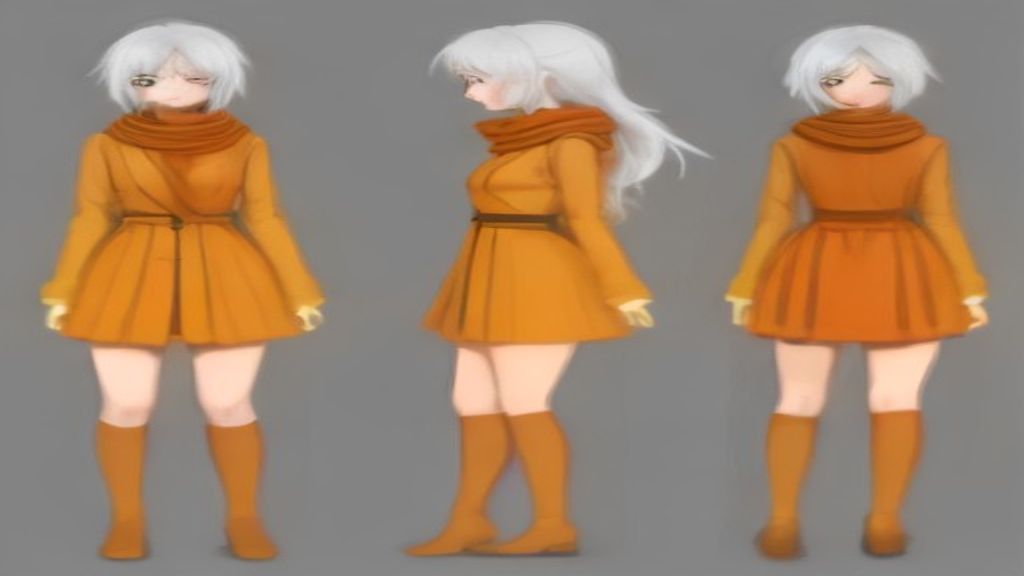
AI comic character consistency is the problem of keeping the same character recognizable across every panel and episode. The usual advice — "write a more detailed prompt" — cannot solve it, because a prompt describes a distribution, not a specific face. This guide explains the root cause, the research behind reference-based identity, and the character-bible workflow that keeps a cast stable.
Build a consistent episode: open the studio with a two-character story →. In Advanced controls, turn on reference sheets for recurring characters; the estimate is shown before generation.
If you have generated more than a few panels with an image model, you know the scene. Panel one: your detective has a scar on her left cheek, a grey-streaked coat, a cybernetic eye that glows faint blue. Panel four: the scar has moved or vanished, the coat is black, and the eye is suddenly both eyes. The story didn't change. The character did.
This is the single most common reason AI-made comics feel broken, and it is worth understanding properly — because the fixes that work all come from the same root cause.
Text is a lossy spec for a face
Start from how a text-to-image model actually works. It turns random noise into a picture, guided at every step by your prompt. The prompt acts as a constraint on a distribution of images — it narrows down what gets rendered, but it doesn't name one specific picture. "A 25-year-old detective with a cybernetic eye" matches millions of possible faces. Your prompt picks a neighborhood; it doesn't pick a house.
That has a blunt consequence for comics: each panel is an independent sample. Unless the model is given something more specific than words, panel four is a fresh roll of the dice that happens to land near panel one — not a re-rendering of the same person. The drift isn't the model being sloppy. It's information theory. A sentence doesn't carry enough bits to specify a face: the distance between "a woman with a scar" and your woman with your scar is all the detail you didn't write, and cannot write, in words.
So the question becomes: what carries identity better than a description?
What the research says
This problem is old enough to have a research lineage, and the findings line up cleanly.
In 2022, Google Research framed it precisely in the DreamBooth paper: text-to-image models "lack the ability to mimic the appearance of subjects in a given reference set and synthesize novel renditions of them in different contexts." Their answer was personalization — fine-tune the model on a handful of photos of one subject until it binds that subject to a unique identifier, then generate the subject in new scenes, poses, and lighting. It works, but the cost is a training run per character.
A year later, IP-Adapter from Tencent AI Lab made the same idea cheap. Instead of fine-tuning, it adds a lightweight adapter (about 22 million parameters) with decoupled cross-attention — one channel attends to your text prompt, a second attends to an image prompt. The image itself becomes part of the instruction. No per-character training; you just show the model a picture and say "this person, but in this scene."
That's the load-bearing insight for comics: an exemplar image carries identity far better than adjectives. By 2024–2025 the capability had moved into mainstream editor-class models — Google's Gemini image models (the "Nano Banana" line) put "keep this person, change everything else" into consumer tools, with multi-image reference input as a first-class feature.
What this means inside a comic pipeline
An episode is the worst case for identity: the same characters rendered across four to twelve-plus panels, in new poses, angles, and lighting, every single time. Three ingredients hold it together in practice — and they're exactly what we built into Lovecomic:
1. One canonical reference sheet per character. Before any panels are drawn, each recurring character gets a single reference image that fixes face, hair, outfit, and palette. You can steer it — upload your own reference photo — but the decision is made once, not re-litigated per panel.
2. References travel with every panel. When a panel is generated, the upstream reference images are passed to the model as image inputs alongside the panel description. The model never renders "your detective" from memory; it renders her from the sheet. This is the IP-Adapter move — identity by exemplar — applied at every frame.
3. The written directives stay frozen too. Identity drifts in two ways: the person drifts, and the style drifts around them. Each art style carries fixed drawing directives (line quality, shading, palette) that are injected into every panel prompt, so fixing the character doesn't leave the rendering style to chance. Color or black-and-white is likewise a project-level setting, not a per-panel re-roll.
Around those three, the pipeline adds the safety net: a vision-QA pass scores generated panels and lists visible issues, and — crucially — panels are regenerable individually. When one face drifts, you reroll one panel against the same references, not the whole episode.
Build a character bible that actually holds
A character bible is not a mood board. It is a short, fixed spec that every panel can be checked against. For each recurring character, write down:
- Identity. Name, role, age, and a one-line personality. This keeps the cast extractor from merging two people or splitting one person into two.
- Face. Face shape, eyes, brows, nose, scars, freckles, and any asymmetric marks. "A scar on her left cheek" is more useful than "determined look."
- Hair. Length, color, texture, parting, and silhouette. Hair is the fastest identity signal at thumbnail size.
- Wardrobe. One fixed outfit, its palette, and accessories. Treat wardrobe as identity, not decoration.
- Props. The objects the character carries or uses — a lighter, a wrench, a specific weapon. Props anchor recognition in action scenes.
- Reference image. One canonical sheet that shows face, front, side, and back. Upload your own photo if you have one; otherwise generate a sheet and lock it.
- World rules. The recurring locations, art style, line quality, and color mode. Characters drift when the world around them drifts.
Keep the bible short enough to read in one sitting and specific enough that two artists would draw the same person. Then reuse it across episodes instead of re-describing the character from memory.
A practical checklist
If you're fighting character drift today, in any tool:
- Decide identity once. Make a reference sheet before the first panel; don't improvise faces as you go.
- Keep the cast small. Every extra recurring character is another identity the references have to pin down in each frame.
- Treat wardrobe as identity. Outfit, hair, and palette are what readers (and models) recognize; describe them in fixed terms and never vary them between panels.
- Fix panels, not episodes. A full reroll re-rolls everything that was already right. Regenerate the one panel that's wrong.
- If a face still won't hold, regenerate the sheet first. A weak reference sheet poisons every panel downstream of it.
Consistency is not a prompt-engineering trick. It's a workflow: define once, reference everywhere, edit locally. That's the same conclusion the research reached — it just took building a comic pipeline around it to make it routine.
How to test consistency across panels
You do not need a formal benchmark. A five-minute check catches most drift:
- Render the same character in three shots. Wide, medium, and close-up. Drift often appears only when the camera distance changes.
- Add a side or back view. Face-only comparisons miss hair silhouette and wardrobe problems.
- Shrink the images. Compare them at thumbnail size. If you cannot tell they are the same person, readers cannot either.
- Change the scene, not the character. Put the character in a new location and lighting. Identity should survive the move.
- Check the signature details. Scar, eye color, hair parting, accessory, palette. These are the bits readers use to recognize someone.
- Fix the sheet first, then the panel. If a detail is drifting repeatedly, the reference is weak. Regenerate the sheet before rerolling individual panels.
Across episodes, the same rule applies: keep the project bible and reference sheets, and let the new episode inherit them. Re-describing the cast from scratch each time is how a series slowly loses its own characters.
FAQ
Why do AI characters change between panels? Each panel is an independent sample from the model's distribution. A text description narrows that distribution but does not identify one specific face, so small details get re-rolled every time. Reference images solve this by giving the model an actual exemplar.
Can a more detailed prompt fix character drift? It helps, but only up to a point. A prompt can specify a scar or a coat color; it cannot reliably specify the exact shape of a face. Use prompts for stable, describable traits and reference images for identity.
What is a character reference sheet? A canonical image of the character — usually face, front, side, and back — that is passed into every panel generation. It fixes the details that words lose.
Do I need to train a LoRA? No. Reference-based identity works without training. LoRA fine-tuning is an option for teams that need an even stronger identity lock, but it is not required for a consistent episode.
Does this work across episodes? Yes, if the project keeps the same cast, reference sheets, and visual rules. New episodes should inherit the bible rather than re-describe everyone from scratch.
What do I do when one panel is wrong? Fix that panel, not the episode. Reroll the single panel against the same references; if the same detail keeps failing, regenerate the reference sheet first.
Related guides
- Story to comic: turn a story into an episode — where the cast and reference sheets fit into the full workflow.
- How to make a vertical webtoon episode — pacing, lettering, and export for phone-first comics.
- How to write a comic prompt that works — what to describe in words, and what to leave to references.
- See consistent characters in the gallery — real episodes made with the same workflow.
References
- Ruiz et al., DreamBooth: Fine Tuning Text-to-Image Diffusion Models for Subject-Driven Generation, Google Research, 2022, arxiv.org/abs/2208.12242.
- Ye et al., IP-Adapter: Text Compatible Image Prompt Adapter for Text-to-Image Diffusion Models, Tencent AI Lab, 2023, arxiv.org/abs/2308.06721.
- Google DeepMind, Gemini image models ("Nano Banana"), deepmind.google/models/gemini/image.